How to Calculate VPD (Simple Step-by-Step Guide)
VPD is calculated by subtracting actual moisture (AVP) from the air’s maximum capacity (SVP), using temperature and humidity. While the formula explains how “thirsty” the air is, most growers rely on charts or calculators for fast, accurate results. Mastering VPD helps you quickly adjust temperature or humidity to keep plants in their ideal growth range.
Table of Contents
What You Need Before Calculating VPD
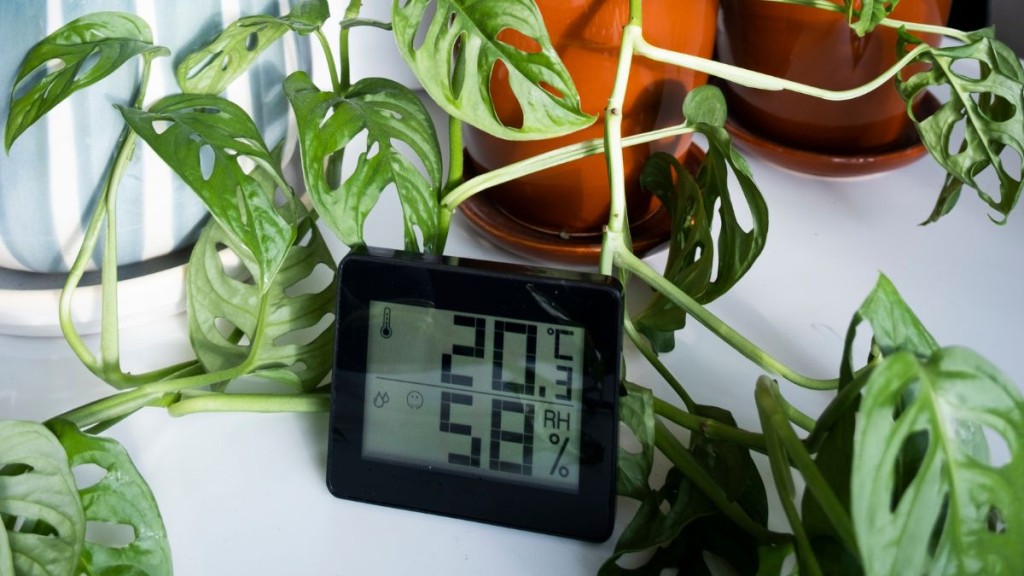
Before you calculate VPD, you only need two things: your air temperature and your relative humidity. That’s it. You can measure both with one simple tool called a thermometer-hygrometer (also called a temp/humidity meter). They are cheap and easy to find online.
Air Temperature is how warm or cool the air is around your plant. You measure it in °C or °F. The temperature of the air tells you how much water vapor the air can hold at its maximum.
Relative Humidity (RH) is how much water is already in the air, shown as a percentage (%). For example, 60% RH means the air is 60% full of water vapor. It still has 40% room left.
Together, these two numbers tell you how “thirsty” the air is — and that is exactly what VPD measures.
One more thing: Leaf Temperature (Optional but Useful)
Leaf temperature is the actual temperature of your plant’s leaf surface. It is usually 1°C to 3°C cooler than the air around it.
Why does this matter? Because VPD is really about what happens at the leaf, not just in the air. If you use leaf temperature instead of air temperature, your VPD result will be more accurate.
For beginners, air temperature is perfectly fine to start with. But as you get more experienced, measuring leaf temperature gives you a more precise picture of what your plant is actually feeling.
If you want to know more about VPD, then check out our guide on Vapour Pressure Deficit (VPD).
The Simple VPD Formula (Easy Version)
The VPD formula sounds scary at first. But once you break it into two simple steps, it makes complete sense.
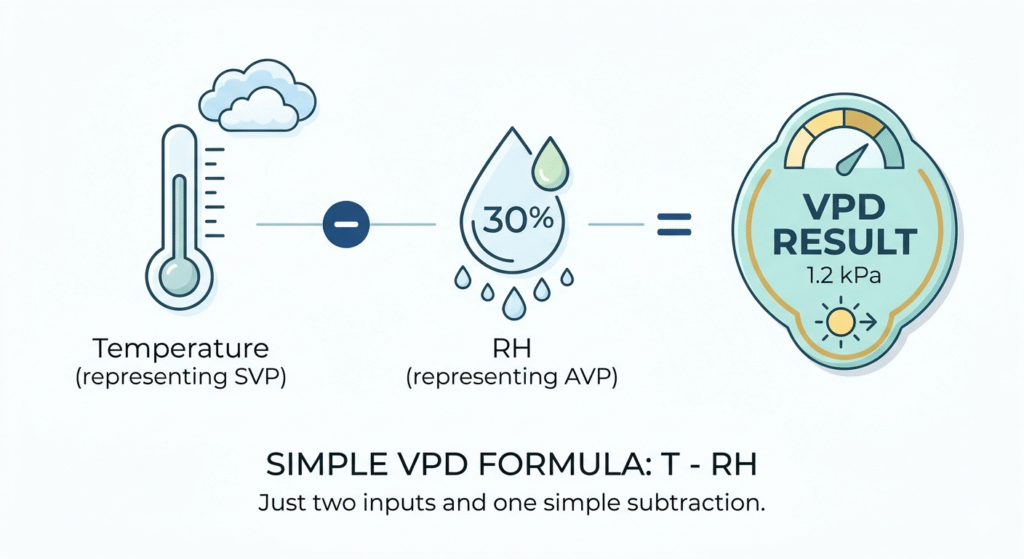
Here is the formula: VPD = SVP − AVP
That’s it. Two numbers. You subtract one from the other.
Now let’s explain what each part means in plain English.
SVP — Saturation Vapor Pressure This is how much water vapor the air can hold at a given temperature. Think of it like an empty cup. A warmer cup can hold more water. A cooler cup holds less. SVP is the size of that cup.
You don’t measure SVP directly. It is calculated from your air temperature using a fixed formula. Don’t worry — a calculator or chart does this for you automatically.
AVP — Actual Vapor Pressure This is how much water vapor is already in the air right now. Think of it as how much water is already inside that cup. AVP depends on both your temperature and your relative humidity.
AVP = SVP × (RH ÷ 100)
So if RH is 60%, you multiply SVP by 0.60. This tells you how full the “cup” already is.
VPD = SVP − AVP When you subtract AVP from SVP, you get VPD. This is the empty space left in the cup — the amount of water vapor the air still wants to pull from your plant.
A bigger number means the air is very dry and pulling hard on your plant. A smaller number means the air is nearly full and not pulling much at all.
Step-by-Step: How to Calculate VPD
Calculating VPD does not require a science degree. Just follow these four steps and you will have your number in under a minute.
Step 1: Measure Your Air Temperature
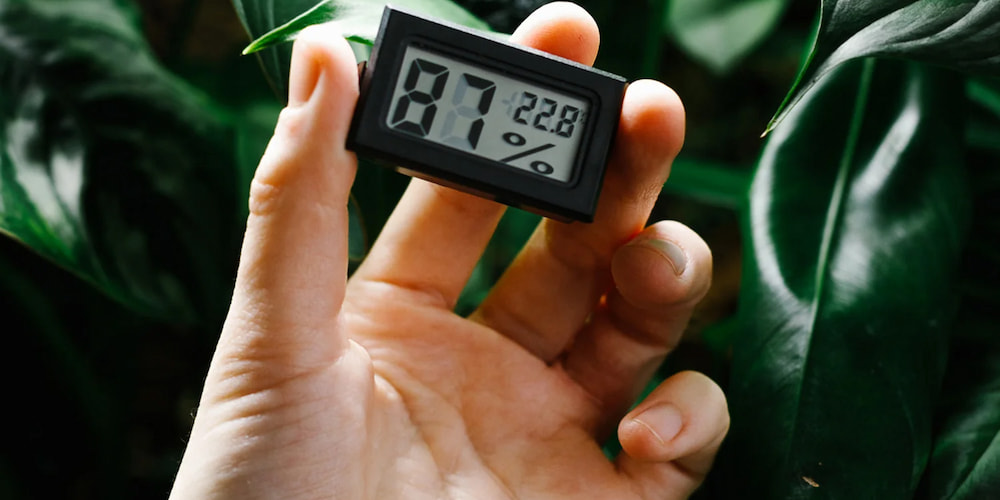
Place your thermometer-hygrometer at plant canopy level — the same height as your plant’s leaves. This is important. The temperature near your lights or near the floor will be different, and those readings will give you the wrong VPD.
Wait a few minutes after placing the meter before you read the number. Let it settle.
Write down your temperature in °C or °F. Pick one and stick with it.
Step 2: Measure Your Relative Humidity
Your same thermometer-hygrometer also shows humidity. Read the RH% number at the same time as your temperature. Both readings should come from the same spot, at the same moment.
Write down your RH percentage. Example: 60%
Step 3: Use a Formula or Tool
Now you have two numbers. You can do one of two things:
Option A — Use the Formula Manually
- Calculate SVP using your temperature: SVP = 0.6108 × e^(17.27 × T ÷ (T + 237.3)) (T = temperature in °C)
- Calculate AVP: AVP = SVP × (RH ÷ 100)
- Subtract: VPD = SVP − AVP
This is accurate but takes effort. Most growers skip this.
Option B — Use a VPD Calculator or Chart (Recommended) Plug your two numbers into our VPD calculator or look them up on our VPD chart. You get your result instantly — no math needed.
For beginners, Option B is the smarter and faster choice.
Step 4: Read Your VPD Value
Your result will be a number measured in kPa (kilopascals). Here is a simple guide to reading it:
VPD Value | What It Means |
Below 0.4 kPa | Air is too humid. Plant can’t breathe well. |
0.8 – 1.2 kPa | Sweet spot. Most plants grow well here. |
Above 1.6 kPa | Air is too dry. Plant is under stress. |
Now you know where you stand — and what to do next.
Real Example (With Numbers)
Let’s stop talking about formulas and actually calculate a real VPD together. We will use simple, common numbers that most indoor growers see every day.
Our Example Setup:
- 🌡️ Air Temperature: 25°C
- 💧 Relative Humidity: 60%
Step 1: Find SVP from Temperature
SVP tells us the maximum water vapor the air can hold at 25°C.
Using the formula:
SVP = 0.6108 × e^(17.27 × 25 ÷ (25 + 237.3))
SVP = 3.17 kPa
In plain English: at 25°C, the air can hold up to 3.17 kPa worth of water vapor when completely full.
Step 2: Find AVP from Humidity
AVP tells us how much water vapor is already in the air right now.
AVP = SVP × (RH ÷ 100) AVP = 3.17 × (60 ÷ 100) AVP = 3.17 × 0.60
AVP = 1.90 kPa
In plain English: the air is already 60% full of water vapor.
Step 3: Calculate VPD
VPD = SVP − AVP VPD = 3.17 − 1.90
VPD = 1.27 kPa ✅
What Does 1.27 kPa Mean?
1.27 kPa falls right inside the ideal range for most plants in their vegetative and flowering stages. The air is pulling moisture from the plant at a healthy rate — not too hard, not too soft. Your plant is transpiring well and nutrient uptake is working as it should.
If you got a number like this in your grow room — you are in a good place.
Don't Want to Do the Math Every Time?
You don’t have to. Our VPD calculator does all of this for you in seconds — and it goes much further than just giving you a number.
Enter your temperature and humidity and you instantly get:
- ✅ Your exact VPD value
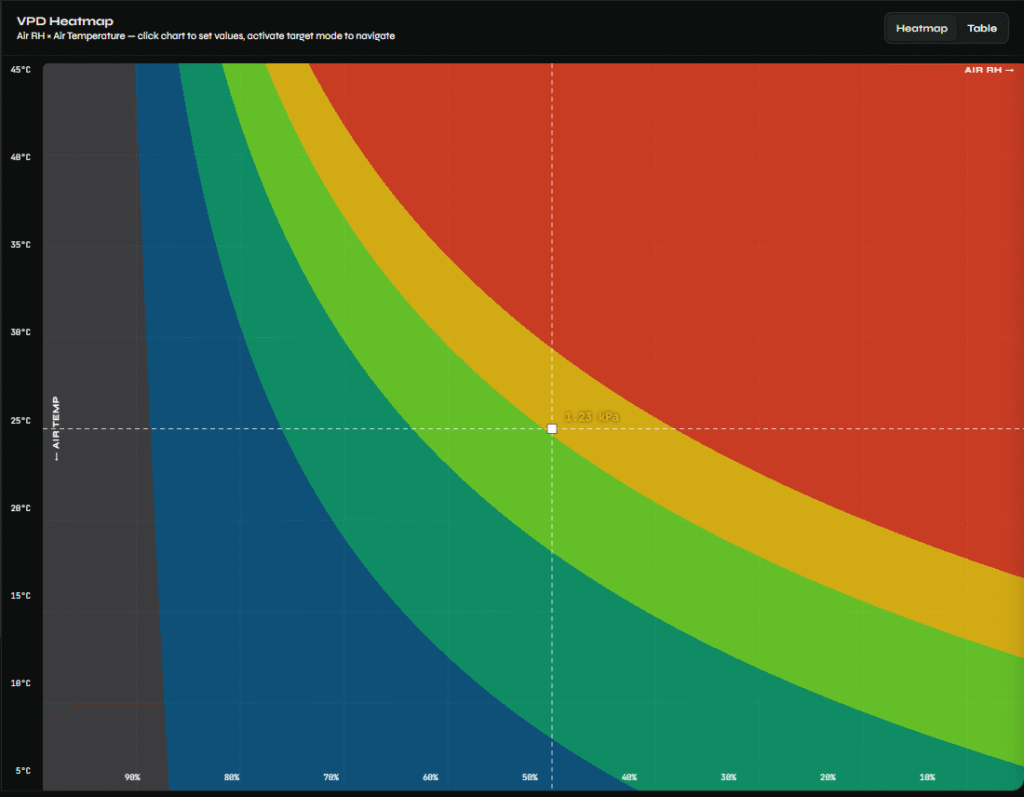
- ✅ An interactive VPD chart showing where you land visually
- ✅ A full data table for quick reference across ranges
- ✅ A target VPD setting where you tell it where you want to be — and it tells you exactly how to get there
It is the fastest and most complete VPD tool available for growers. No math. No guesswork. Just results.
Easiest Way: Use a VPD Calculator or Chart
Now that you understand how VPD is calculated, here is the truth that every experienced grower knows:
Nobody does this math by hand.
Not because it’s impossible. But because it’s slow, easy to mess up, and completely unnecessary when better tools exist.
Why Manual Calculation Gets Frustrating Fast
Every time your temperature or humidity changes — which happens constantly in a grow room — your VPD changes too. That means recalculating over and over again throughout the day.
One small mistake in the formula gives you a wrong number. A wrong number leads to a wrong decision. A wrong decision stresses your plants.
Manual math made sense before good tools existed. It doesn’t anymore.
Option 1: Use a VPD Chart
A VPD chart is a printed or digital grid. You find your temperature on one axis and your humidity on the other. Where they meet, you read your VPD value.
It is faster than the formula. But it still has limits:
- You have to eyeball the number between grid lines
- It doesn’t tell you what to do with your result
- It can’t give you personalized recommendations
A chart is a good reference tool. But it’s a passive one.
Option 2: Use a VPD Calculator (Smarter and Faster)
A good VPD calculator removes all the friction. You enter two numbers — temperature and humidity — and everything else is done for you instantly.
Our VPD calculator is built specifically for growers and goes far beyond a basic number:
- Exact VPD Value — Calculated instantly, no math needed
- Interactive VPD Chart — See exactly where your current conditions sit on a live visual chart
- Full Reference Table — Browse VPD values across all temperature and humidity combinations in one place
- Set Your Target VPD — Tell the calculator where you want to be, and it gives you a full step-by-step recommendation on how to get there by adjusting your temperature or humidity
This means you are not just getting a number. You are getting a complete picture of your grow environment and a clear action plan.
We have the best VPD calculator on the market. It not only calculates VPD, but also displays an interactive chart and a data table, and allows users to set a target VPD level to receive personalized recommendations. It supports all types of crops, including cannabis, leafy greens, flowers, early vegetables, cucumbers, and tomatoes.
Want to know how to read the chart visually? Check out our guide: How to Read a VPD Chart (Step-by-Step)
What Most Growers Get wrong When Calculating VPD
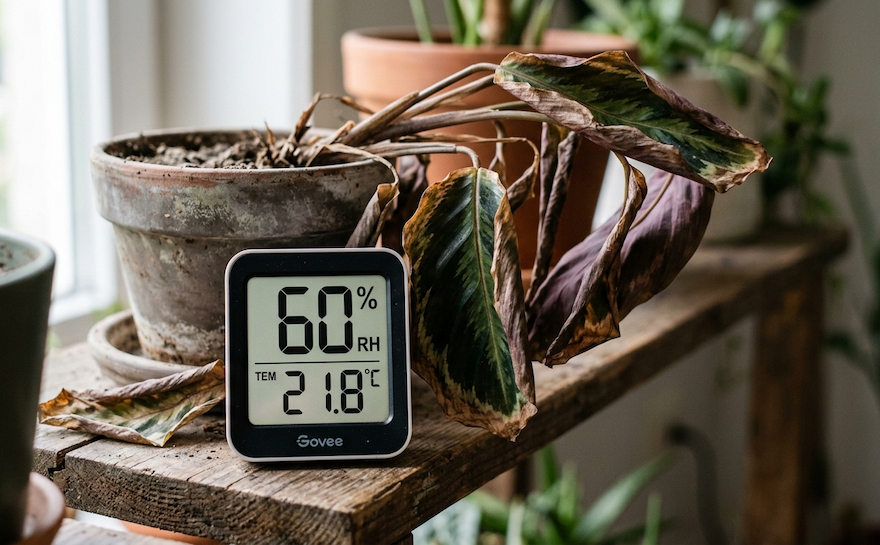
Even growers who understand VPD make small mistakes that throw off their numbers. The frustrating part is that these errors are invisible. Your calculator gives you a result — it just gives you the wrong result. And you don’t know it.
Here are the most common mistakes and exactly how to avoid them.
Mistake 1: Measuring Temperature in the Wrong Spot
This is the most common error of all.
Many growers place their sensor near the wall, near the floor, or right under a grow light. These spots are either too hot or too cool compared to where your plant actually lives.
VPD is about what your plant experiences — not what the room feels like in general. If your sensor is not at canopy level (the height of your plant’s leaves), your temperature reading is wrong and your VPD result is wrong too.
✅ Fix: Always place your sensor at the same height as the top of your plant canopy. Move it as your plants grow taller.
Mistake 2: Ignoring Leaf Temperature
Air temperature and leaf temperature are not the same thing. A plant’s leaf surface is usually 1°C to 3°C cooler than the surrounding air. This is because leaves release moisture constantly, which naturally cools them down — just like how sweating cools your skin.
When you use air temperature instead of leaf temperature, your SVP calculation is slightly off. This makes your final VPD number higher than it really is. You might think your plant is under more stress than it actually is — and make unnecessary changes.
✅ Fix: For basic growing, air temperature is acceptable. For more precise results, use an infrared thermometer to measure leaf surface temperature directly and enter that into your calculation instead.
Mistake 3: Mixing Up °C and °F
The VPD formula is built for °C (Celsius). If you measure temperature in °F and plug that number directly into the formula without converting, your result will be completely wrong.
For example: 77°F and 25°C are the same temperature. But if you put 77 into the SVP formula thinking it is Celsius, you get a wildly different and incorrect result.
This mistake is surprisingly common, especially for growers in the United States where °F is the standard.
✅ Fix: Always convert °F to °C before calculating. The conversion is simple: (°F − 32) × 0.5556 = °C Or just use a calculator that lets you choose your unit — so the conversion happens automatically.
Mistake 4: Taking Readings at the Wrong Time
Humidity and temperature in a grow room change throughout the day. Lights-on and lights-off periods create very different conditions. Taking one reading in the morning and assuming it represents your whole day is a mistake.
Your VPD during lights-on could be 1.2 kPa. During lights-off, it might drop to 0.6 kPa. Both matter. Acting on only one reading means you are missing half the picture.
✅ Fix: Take readings during both your lights-on and lights-off periods. Ideally, monitor continuously with a data-logging sensor.
Mistake 5: Forgetting to Update VPD as Plants Grow
A seedling needs a very different VPD than a plant in full flower. Many growers set their environment once and never revisit it as their plants move through growth stages.
What was a perfect VPD in week two can become stressful by week six.
✅ Fix: Check your target VPD range every time your plants enter a new growth stage. Seedlings, vegetative, and flowering stages all have different ideal ranges.
Quick Fix If Your VPD Is Too High or Too Low
You calculated your VPD. Now what?
If your number is outside the ideal range, don’t panic. VPD is just a signal. It is telling you that your temperature or humidity needs a small adjustment. Most fixes take less than five minutes.
Here is exactly what to do.
First: Know Your Target
Before fixing anything, know what you are aiming for. A simple starting guide:
Growth Stage | Ideal VPD Range |
Seedlings / Clones | 0.4 – 0.7 kPa |
Vegetative Stage | 0.7 – 1.0 kPa |
Flowering Stage | 1.0 – 1.5 kPa |
Late Flower | 1.2 – 1.6 kPa |
If Your VPD Is Too HIGH (Air Is Too Dry)
A high VPD means the air is pulling too much water from your plant. Your plant is losing water faster than it can replace it. Leaves may curl, tips may brown, and growth slows down.
Your air needs more moisture.
Quick fixes — try these in order:
- Increase humidity first. Turn up your humidifier or add one if you don’t have one. This is the fastest fix.
- Lower your temperature slightly. Cooler air holds less “hunger” for moisture. Even a 1°C to 2°C drop can bring VPD down noticeably.
- Group plants closer together. Plants release moisture as they breathe. More plants in one area naturally raises humidity around them.
If Your VPD Is Too LOW (Air Is Too Wet)
A low VPD means the air is already so full of moisture that your plant can barely release any water. When plants can’t transpire properly, nutrients stop moving through them. Growth stalls. Mold and mildew risk increases.
Your air needs less moisture.
Quick fixes — try these in order:
- Decrease humidity first. Turn on or turn up your dehumidifier. Increase air circulation with fans.
- Raise your temperature slightly. Warmer air can hold more vapor, which increases the air’s “hunger” and raises VPD.
- Improve air exchange. Bring in fresh, drier air from outside your grow space if possible. Stale humid air builds up fast in sealed rooms.
A Simple Rule to Remember
VPD too high → Add moisture or lower temp
VPD too low → Remove moisture or raise temp
You are always adjusting just two things: humidity and temperature. That’s all VPD control ever comes down to.
Not Sure How Much to Adjust?
This is where most growers waste time — guessing how much to raise or lower their humidity or temperature to hit their target VPD.
Our VPD calculator removes that guesswork completely. Set your target VPD, enter your current conditions, and it tells you exactly what to change and by how much. No trial and error. No stress.
👉 Ready to take full control of your grow environment? Read our full guide: How to Control VPD in a Grow Room
Simple Way to Remember This
You have learned a lot in this guide. Formulas, steps, mistakes, fixes. That’s a lot to hold in your head when you are standing in your grow room at 11pm trying to figure out why your plants look stressed.
So let’s compress everything into one simple idea you will never forget.
The One Sentence That Explains VPD
“The air is either thirsty or full — and your plant pays the price either way.
That’s it. VPD is just a measurement of how thirsty the air is.
- Thirsty air pulls too hard on your plant. Your plant dries out and stresses.
- Full air can’t accept any more moisture. Your plant can’t breathe and growth stalls.
- Balanced air pulls just enough. Your plant transpires perfectly and thrives.
The Simple Memory Shortcut
If you want to remember how to fix VPD quickly, use this:
Temperature UP → VPD UP
Temperature DOWN → VPD DOWN
Humidity UP → VPD DOWN
Humidity DOWN → VPD UP
Notice the pattern:
Temperature and VPD always move in the same direction. Humidity and VPD always move in opposite directions.
Once this pattern clicks, you will never feel lost again. You don’t need to remember formulas. You just need to remember the direction things move.
The 3-Word Check
Every time you check your grow room, ask yourself just three words:
“Thirsty or Full?”
Pull out your meter. Check your VPD number. If it’s too high — air is too thirsty. If it’s too low — air is too full. If it’s in range — you are good. Walk away.
Three words. That’s the whole system.
One Last Thing
You don’t need to memorize charts or formulas to be a great grower. You just need the right tool that does the work for you — and the understanding to trust what it tells you.
You now have both.